As the global energy transition accelerates, innovative policy mechanisms are required to mobilize capital and reduce risks associated with low-carbon investments. Contracts for Difference (CfD) play a critical role in reducing revenue uncertainty, enabling large-scale investment in renewable energy and low-carbon technologies.
Addressing the Global Investment Gap
Achieving global climate targets will require around USD 5.6 trillion in annual energy sector investment from 2025 to 2030 as the world transitions to Net Zero (BloombergNEF, 2026). To bridge this gap, significant investment in low-carbon technologies, such as renewables, hydrogen, and carbon capture, is necessary. However, these technologies often involve high capital costs and volatile revenues, making financing difficult. This has led to the development of revenue-stabilizing mechanisms, most notably the CfD mechanism.
How the CfD Mechanism Works
The CfD mechanism was introduced by the UK government in 2014 as part of the Electricity Market Reform (EMR1), serving as the main method for incentivizing renewable energy projects. At its core, CfD stabilizes revenues for low-carbon energy projects by protecting them from fluctuations in wholesale electricity market prices, providing developers with more predictable income through a contract with a government-backed counterparty.
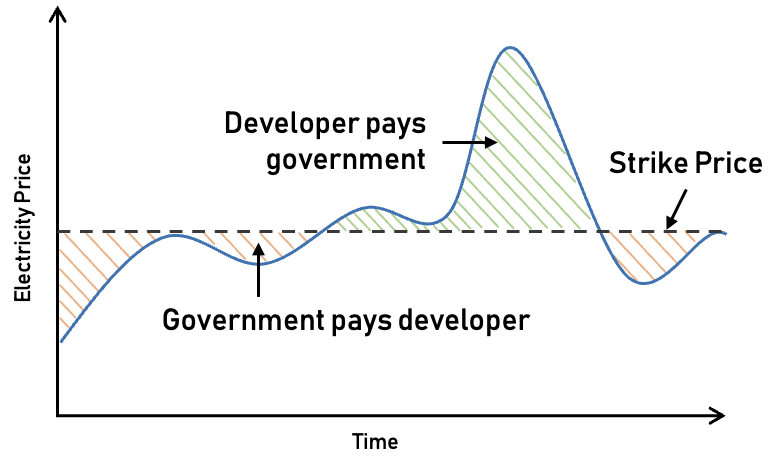
Figure 1. Contract for Difference (CfD) settlement mechanism
To illustrate this, when market prices are low, the government provides a difference payment. Conversely, when market prices are high, the developer returns the excess revenue, creating a two-way payment mechanism that balances risks between the government and the developer. In practice, this mechanism is widely applied in the power sector and is operationalized through a set of defined financial parameters:
- Strike Price: The strike price is the fixed price guaranteed by the government for the electricity generated by a low-carbon energy project, set at the time of award.
- Market Reference Price: Intermittent Market Reference Price (IMRP2) is the actual price of electricity sold on the market. This fluctuates following market conditions.
- Difference Payment: The difference payment is the payment made by either the government to the developer or the developer to the government.
Case Study: UK’s Hornsea 2 Offshore Wind Project
The UK’s CfD scheme has been pivotal in scaling up renewable energy in the country. The Hornsea 2 Offshore Wind Project, developed by Ørsted, secured a CfD in the second allocation round in 2017. Hornsea 2 is a major offshore wind farm, with a 1.3 GW capacity, and it became fully operational in 2022. The project’s initial strike price of £57.5/MWh was critical in providing long-term revenue certainty for Hornsea 2:
- If the strike price is £57.5/MWh and the market price is £40/MWh, the government pays the difference of £17.5/MWh to the developer.
- If the strike price is £57.5/MWh and the market price is £80/MWh, the developer pays back the excess of £22.5/MWh to the government.
Hornsea 2 has successfully contributed to the UK’s renewable energy capacity. The project provides clean electricity to over 1.4 million homes, significantly contributing to the UK’s decarbonization goals. It is also one of the largest operational offshore wind farms in the world, demonstrating the effectiveness of the CfD scheme in facilitating large-scale renewable energy projects. UK’s CfD’s are awarded through competitive auctions managed by National Grid ESO3, with overall policy set by the BEIS4 UK. Developers submit bids indicating their minimum strike price and project capacity, with contracts awarded by the Low Carbon Contracts Company (LCCC5).
While the CfD mechanism was first introduced in the UK, similar approaches have since been adopted globally as auction-based schemes in Germany, Denmark, and Australia’s power sector implements comparable models to attract investment and reduce financial risks in the renewable energy sector.
CfDs Beyond Power: Carbon Contracts for Difference (CCfD)
While CfDs are widely applied in the power sector, similar mechanisms have been developed to support decarbonization in hard-to-abate industries, particularly through Carbon Contracts for Difference (CCfD). Introduced in countries such as Germany, CCfDs are designed to bridge the cost gap between conventional production and low-carbon alternatives. Under the CCfD scheme, companies submit bids based on the CO₂ price required to make their low-carbon investments economically viable and uses a two-way payment mechanism similar to CfDs.
During the first round of Germany’s CCfD in October 2024, grants were provided for projects involving the conversion of production facilities from fossil fuels to electricity or hydrogen, and included major industrial players such as BASF SE66. For the upcoming 2026 auction with €6 billion in funding, the German ministry has specifically expanded the eligibility to include Carbon Capture and Storage (CCS) and Carbon Capture and Utilisation (CCU) projects.
Key Success Factors for CfD-Supported Projects
The success of Hornsea 2 highlights several critical factors in ensuring the effectiveness of CfD-supported projects:
- Competitive Auction Design: The CfD auction process ensures that projects are awarded at the lowest possible cost to the government, reducing subsidy costs.
- Long-Term Policy Certainty: The stable regulatory environment provided by the CfD scheme enabled Ørsted to secure financing and attract private investment.
- Clear Institutional Structure: Clear roles for the government, developers, and financial institutions facilitated smooth project development and execution.
- Transparent Price Discovery: Usage of IMRP ensured that the CfD payments accurately reflected real-time market conditions, providing fairness and reducing uncertainty.
- Electricity Market Reform is a set of policy measures introduced by the UK government in 2010 to ensure a secure, low-carbon, and affordable electricity supply for the future. ↩︎
- Intermittent Market Reference Price (IMRP) is a weekly updated, hourly, volume-weighted average of day-ahead power prices. ↩︎
- National Grid Electricity System Operator (ESO) is a public body which matches supply from generators with demand from consumers, ensuring the electricity grid runs securely and efficiently. ↩︎
- BEIS: Department for Business, Energy & Industrial Strategy. ↩︎
- Low Carbon Contracts Company is a UK government-owned entity which acts as the counterparty to CfDs, managing contracts that support technologies like wind, solar, and nuclear. ↩︎
- Badische Anilin- & Soda-Fabrik (BASF SE) is a German multinational company specializing in chemicals, materials, agricultural solutions, etc. ↩︎